

Table of Contents
- Understanding Size Chart Basics
- How to Measure Body for Clothing Accurately
- The Difference Between Alpha and Numeric Sizing
- How to Measure Inseam for Perfect Pant Length
- Why Size Charts Vary by Brand and Garment Type
- Converting International Sizes and Reading Multiple Standards
- Using Size Charts to Find Your Fit
- Conclusion
Last Updated: August 15, 2026
Understanding Size Chart Basics
A size chart is a reference guide that translates body measurements into standardized garment sizes, helping you match your physical dimensions to the clothing available in a brand's collection. Size charts vary significantly between manufacturers, a medium from one brand might fit completely differently than a medium from another. Understanding how to read these charts is essential for finding clothing that actually fits.
Most people skip the size chart and order based on what they've worn before, but this fails because different brands use different sizing systems, ease allowances, and construction methods. A size chart bridges that gap by showing exactly what measurements correspond to each size option.
How to Measure Body for Clothing Accurately
Measuring your body correctly is the first step toward reading any size chart effectively. Inaccurate measurements lead to ordering the wrong size, even when you're reading the chart perfectly.
Start by wearing minimal clothing or undergarments only. Stand in front of a mirror with your arms relaxed at your sides. Have someone help if possible, though you can measure yourself by wrapping the tape around your body and checking where it meets. The tape should sit parallel to the floor and be snug but not tight enough to compress your skin. You should be able to slide a finger under the tape.
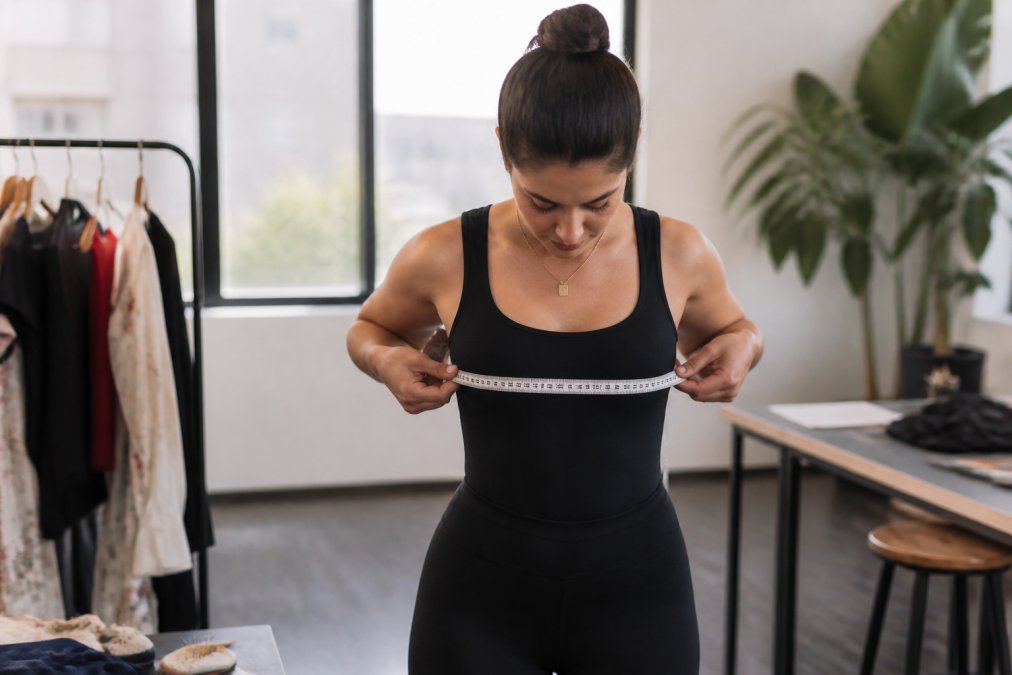
Key Measurement Points: Bust, Waist, Hip, and Inseam
Bust circumference is measured at the fullest part of your chest. Stand straight and measure around your body at the point where your breasts are widest, typically a few inches below your collarbone.
Waist measurement is taken at the narrowest point of your torso, usually about an inch above your belly button or at your natural waistline where your body bends when you lean to the side.
Hip measurement is recorded at the fullest part of your hips and buttocks. Stand with your feet about six inches apart and measure around the widest point. This is critical for bottoms like pants, skirts, and rompers.

Inseam is the inside leg measurement from your crotch to your ankle. This determines pant length and requires a slightly different technique covered in the next section.
The Difference Between Alpha and Numeric Sizing
Two primary sizing systems exist in clothing: alpha sizing and numeric sizing.
Alpha sizing uses letters: XS, S, M, L, XL, XXL. This system is common in casual wear and contemporary brands. The advantage is simplicity; most people understand that M is medium and L is large. The disadvantage is that there's no standardized definition of what "medium" means across brands. One company's medium might have a 36-inch bust, while another's has a 38-inch bust.
Numeric sizing uses numbers: 0, 2, 4, 6, 8, 10, 12. This system is traditional in women's dress sizing. The numbers originally corresponded to specific measurements, but like alpha sizing, actual dimensions vary by brand and have shifted over decades due to vanity sizing.
Some brands use international sizing standards that combine both systems, labeling garments as "S / EU 36 / UK 8." The key insight: the label size matters less than how the garment actually measures. Always compare your body measurements to the garment measurements on the size chart, regardless of the sizing system used.
How to Measure Inseam for Perfect Pant Length
Inseam measurement is critical for pants fit. The inseam is the length of the inside seam of a pant leg, measured from the crotch to the hem.
To measure accurately, wear the shoes you plan to wear with the pants. Stand in those shoes and have someone measure from your crotch down the inside of your leg to your ankle bone. The tape should follow the inside seam line, staying parallel to your leg.
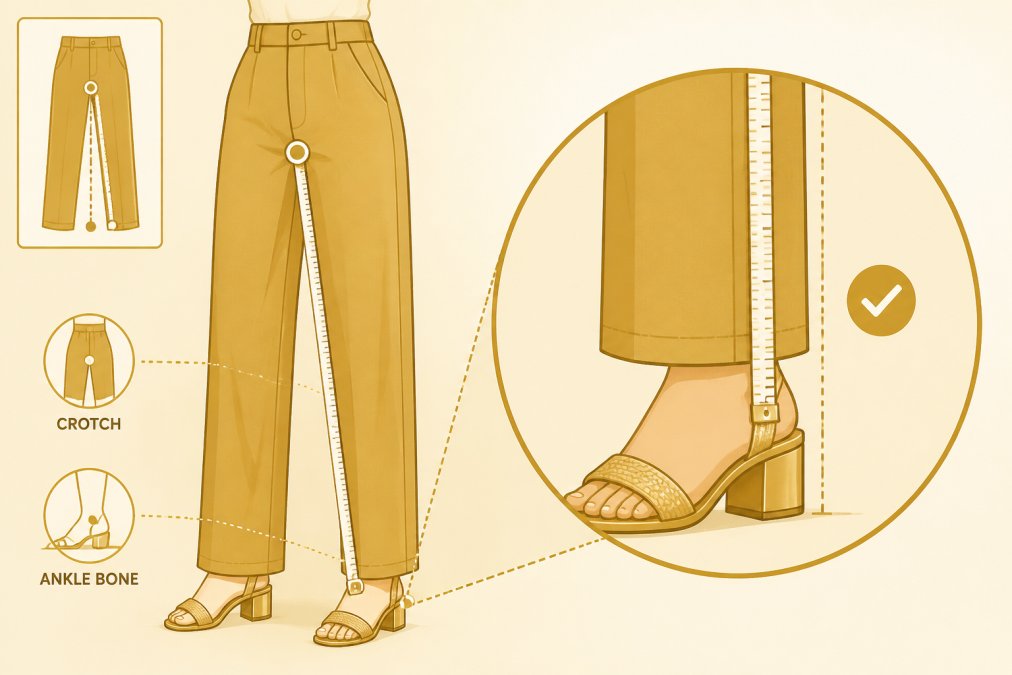
If measuring yourself, stand in front of a mirror and use a measuring tape to mark the distance from your crotch to your ankle. Alternatively, measure an existing pair of pants that fit well in the length by laying them flat and measuring from the crotch seam to the hem.
Common mistakes include measuring over clothing, measuring with bent legs, or measuring to the floor instead of to your ankle bone. Each error throws off your inseam by 1-3 inches.
Why Size Charts Vary by Brand and Garment Type
Size charts vary because there's no federal mandate requiring standardized sizing in the clothing industry. Each manufacturer decides their own measurements, fit philosophy, and ease allowance.
Garment type also affects sizing. A t-shirt size chart shows different measurements than a dress size chart because the intended fit is different. A t-shirt is typically worn loose, while a dress might be fitted or have a specific silhouette.
Fabric composition influences sizing too. Stretchy knit fabric allows for tighter sizing because the material gives, while rigid woven fabric requires more room. Brands often size stretchy pieces smaller than non-stretch pieces.
Ease Allowance and Fit Styles Explained
Ease allowance is the extra room built into a garment beyond your actual body measurements. It's the difference between your body measurement and the garment measurement at that same point.
A fitted garment might have 1-2 inches of ease at the bust. A relaxed-fit garment might have 3-4 inches. An oversized garment can have 6+ inches. This is why the same size fits so differently depending on the style.
When you look at a size chart, you're seeing garment measurements, not body measurements. If a size medium shows a 38-inch bust measurement, that garment has built-in ease. If your bust measures 36 inches, a size medium with 2 inches of ease will fit you with a fitted silhouette. The same size medium from a different brand with 4 inches of ease will feel loose and relaxed.
Different fit styles serve different purposes. Slim-fit garments have minimal ease and hug your body closely. Regular-fit garments have moderate ease for comfortable everyday wear. Relaxed-fit garments have generous ease for a loose feel. Oversized garments have substantial ease for that deliberately large aesthetic. The size chart shows exactly which fit style each size corresponds to.
Converting International Sizes and Reading Multiple Standards
If you're ordering from international brands, you'll encounter multiple sizing standards: US sizing, European sizing, and UK sizing. These don't convert on a 1:1 basis.
US sizing uses numbers starting from 0 (0, 2, 4, 6, 8, 10, 12, 14, etc.).
European sizing uses even numbers starting from 32 (32, 34, 36, 38, 40, 42, 44, etc.). European sizes are typically 4 numbers larger than US sizes. A US size 6 is roughly equivalent to a European size 36.
UK sizing uses numbers similar to US sizing but with different conversions. A UK size 8 is roughly equivalent to a US size 4.
When reading a size chart with multiple standards, locate your body measurements first, then follow the row across to see what size that corresponds to in each system. A good size chart will show all three systems so you can order confidently.
Consumer Reports guide to clothing sizing standards provides detailed conversion charts if you need to cross-reference between systems.
Using Size Charts to Find Your Fit
The practical process involves five steps. First, measure your body and write down your bust, waist, hip, and inseam measurements. Second, locate the size chart for the specific garment. Third, find the row that matches your largest measurement, most garments are sized based on bust or hip. Fourth, check the other measurements in that row to ensure they work for your body. Fifth, read the fit description and ease allowance information to understand how that size will feel.
Consider the garment type when making your final decision. A dress that's slightly loose is often more flattering than one that's slightly tight. A t-shirt that's oversized feels comfortable for casual wear. Pants should fit at your natural waist with minimal excess fabric.
When you're between sizes, consider the fit style and your personal preference. If the garment is designed to be fitted and you're between a small and medium, choose the medium for comfort. If the garment is designed to be oversized, the smaller size might give you the aesthetic you want.
Kimberly's Dream's size charts include detailed fit descriptions for each garment type. Our White Ribbed Corduroy Oversized Sweatshirt includes a relaxed-fit size chart showing how the generous ease allowance creates that comfortable silhouette. Our Beau Blue Smocked Cuffs Flared Denim Shirt Mini Dress provides measurements for a fitted silhouette with minimal ease.


Conclusion
Reading clothing size charts correctly transforms online shopping from a frustrating guessing game into a confident, reliable process. The key is understanding that your body measurements and garment measurements are two different things, and that size charts bridge that gap. By measuring accurately, understanding ease allowance, and comparing your measurements to the garment dimensions on the chart, you eliminate the uncertainty that leads to returns and poor fit.
At Kimberly's Dream, we design our pieces with specific fit intentions, from relaxed and comfortable to fitted and elegant, and our size charts reflect those design choices. When you use our detailed size charts to find your correct size, you're investing in pieces that will feel as good as they look. Choose Kimberly's Dream for clothing that combines chic design with the comfort of a perfect fit.
Frequently Asked Questions
How do I know if I should use my body measurements or garment measurements from a size chart?
Use your body measurements to find your size on the chart first. Garment measurements show the actual dimensions of the clothing item itself, which includes ease allowance (extra room for comfort and movement). Compare your body measurements to the garment measurements listed, if your bust is 36 inches, look for a size where the garment bust measurement is 38-40 inches, depending on the fit style. This ensures proper comfort and fit.
Why do my measurements suggest different sizes across brands?
Sizing inconsistency occurs because manufacturers use different standardized sizing systems and add varying amounts of ease allowance. One brand's size 8 may have a 38-inch bust, while another's has 36 inches. Always consult the specific size chart for each brand rather than assuming your usual size will fit. Check garment labels and compare your body measurements directly to that brand's chart to avoid sizing discrepancies.
What does ease allowance mean, and how does it affect my fit?
Ease allowance is the extra room built into a garment beyond your body measurements. A relaxed fit might add 2-4 inches of ease, while a slim fit adds only 0.5-1 inch. This affects how snug or loose the clothing feels. If you prefer a fitted look, choose a size with minimal ease; for comfort and movement, select one with more ease. Understanding this helps you choose the right size chart category for your preferred fit type.
How do I convert between US, UK, and Euro sizes?
US sizes don't convert directly because each system uses different numbering. A US size 8 is roughly a UK size 12 and a Euro size 36-38, but these are approximations. Always refer to the brand's size chart for exact conversions rather than relying on general rules. Many retailers, including Kimberly's Dream, provide size conversion charts showing US, UK, and Euro sizes side by side for accuracy.
This article was written using GrandRanker
0 comments